

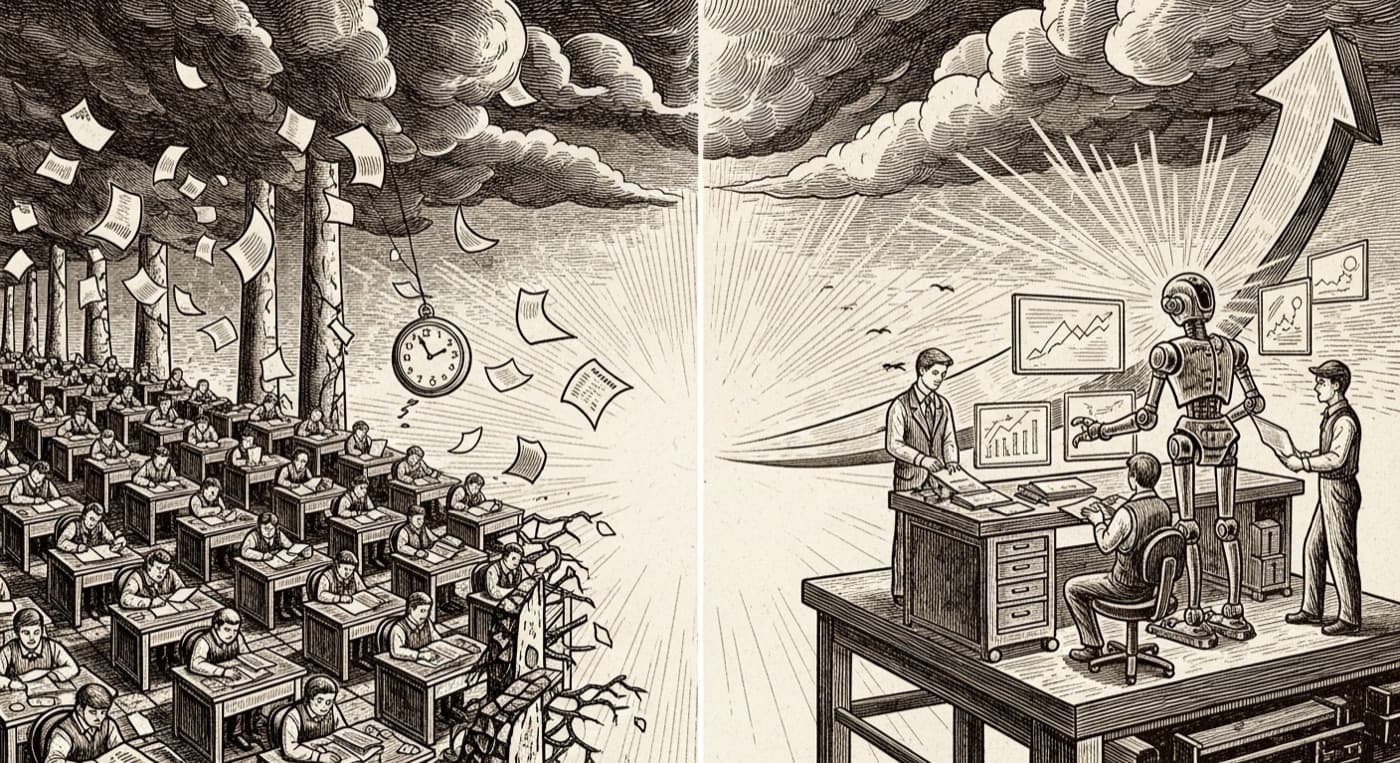
Ask anyone who runs a development agency what the last two years felt like, and if they're honest, they'll say the same thing: the ground moved. AI-assisted development didn't just make programmers faster - it broke the economics that the entire agency industry was built on. The agencies that pretend nothing changed are quietly bleeding. The ones that rebuilt around the new reality are shipping more, with smaller teams, for happier clients.
We run a development agency, so this isn't an outsider's take. This is what we're seeing from inside the industry - what's dying, what's surviving, and what the agency of the next five years actually looks like. Whether you run an agency or you're about to hire one, this is worth ten minutes of your time.
The Old Model Was Already Broken - AI Just Exposed It
The classic agency model worked like this: sell a big scope, staff it with a big team, bill by the hour, and stretch the timeline because more hours meant more revenue. The incentives were upside down from day one. The client wanted the product finished fast; the agency got paid more the slower it went. Everyone in the industry knew this. Nobody said it out loud.
That model survived for decades because writing software was genuinely slow and expensive. If it took five developers six months to build an app, clients had no choice but to pay for five developers for six months. The inefficiency was the moat.
Then the cost of writing code collapsed. A senior developer working with modern AI tooling now produces what a small team produced three years ago. Boilerplate, CRUD screens, integrations, test suites - the work that used to fill junior developers' timesheets - is largely automated. The moat drained overnight.
Three Agency Deaths Happening Right Now
1. The body shop is dying
Agencies that sold headcount - 'you need four developers, two QA engineers, and a project manager for eight months' - are in serious trouble. Clients have done the math. They've seen a two-person team ship in weeks what a ten-person vendor quoted in quarters. The rate card built on stacking bodies onto a project doesn't survive contact with that comparison.
2. The hourly bill is dying
Hourly billing made sense when effort and output were roughly proportional. They no longer are. If AI helps us finish a feature in three hours that used to take thirty, billing hourly punishes us for being efficient. So the industry is moving - faster than most people realize - toward fixed-scope, fixed-price, and outcome-based pricing. Clients don't buy hours. They never wanted hours. They wanted a working product, and now they can finally pay for exactly that.
3. The 'we build anything' generalist is dying
When building was hard, being able to build at all was a differentiator. Now that a motivated founder can get a rough prototype out of AI tools in a weekend, 'we can build it' means nothing. The question clients are actually asking has changed from 'can you build this?' to 'do you know what's worth building, and will it hold up in production?' Agencies with no opinion, no specialty, and no product judgment have nothing left to sell.
What the Agency of the Next Five Years Looks Like
Small, senior, and AI-leveraged
The winning shape is no longer a pyramid - one architect on top of a pile of juniors. It's a small team of experienced engineers, each operating with AI leverage that multiplies their output. Seniority matters more than ever, not less, because the job has shifted from writing code to directing, reviewing, and correcting it. AI produces plausible code at incredible speed; it takes real experience to know when plausible is wrong. The engineers who thrive are the ones who can smell a bad architecture decision before it ships.
Judgment as the product, not code
Code is becoming a commodity. Judgment isn't. Knowing which features to cut from an MVP, which architecture will survive scale, which third-party service will still exist in three years, where the security landmines are, why users abandon a signup flow - none of that got cheaper. The future agency sells exactly this: taste, judgment, and accountability, delivered through software. The code is the medium, not the product.
Product partner, not ticket-taker
The vendor relationship - client writes requirements, agency executes them silently, everyone discovers at the end that the requirements were wrong - is being replaced by something closer to a fractional product team. The agency of the next five years pushes back on bad ideas, proposes cheaper paths to the same outcome, and treats the client's budget like its own money. Ironically, AI makes this more valuable: when execution is fast, choosing the right thing to execute becomes the whole game.
Speed as the default, not the premium
Six-month timelines for standard products are over. Not because teams work harder, but because the tooling changed. What used to be a six-month build is now a six-to-eight-week build with better test coverage. Agencies that still quote old-world timelines are either not using modern tooling or padding the estimate. Clients are learning to recognize both.
Maintenance becomes the relationship
Here's the part fewer people talk about: as AI generates more of the world's code, the volume of software that exists - and needs to be understood, secured, and maintained - is exploding. A lot of it was generated quickly by people who couldn't evaluate what they were shipping. Cleaning up, hardening, and extending AI-built products is quietly becoming one of the biggest categories of agency work. The one-off project fades; the long-term technical partnership grows.
What Doesn't Change
It's easy to overcorrect and declare that everything is different now. It isn't. The fundamentals that made agencies worth hiring in 2015 are the same ones that will make them worth hiring in 2030:
- Trust - someone has to be accountable when production goes down at 2 a.m., and it won't be a chat window
- Understanding the business - software fails far more often from misunderstood problems than from bad code
- Communication - clear scope, honest timelines, and bad news delivered early
- Security and reliability - AI can write the code, but someone with skin in the game has to own the consequences
- Finishing - the last 10% of a product (edge cases, polish, app store review, real-device testing) is still where most projects die, and it's still brutally human work
“Clients never paid agencies to type. They paid them to be responsible. That part isn't going anywhere.”
If You're Hiring an Agency in 2026, Ask These Questions
The gap between agencies that adapted and agencies that didn't has never been wider, and the websites look identical. Here's how to tell them apart in one conversation:
- 1How do you use AI in your workflow? A confident, specific answer is good. Evasion is bad. 'We don't, it's a fad' is disqualifying - and so is 'AI does everything,' because then what are you paying them for?
- 2What would you cut from my scope? A real partner will immediately start trimming your feature list. A body shop will happily quote all of it.
- 3Who exactly will work on my project? Small and senior beats large and anonymous. If they can't name the people, the people are interchangeable - and so is the quality.
- 4How do you price? Outcome- or milestone-based pricing means their incentives point the same direction as yours. Pure hourly billing on a well-defined project should make you ask why.
- 5What happens after launch? If there's no real answer about maintenance, monitoring, and iteration, you're buying a handoff, not a partnership.
- 6Show me something you shipped that's still running. Not screenshots - a live product with real users. Shipping to production and surviving contact with real usage is the credential that still matters.
Where This Is All Heading
Push the trend lines out five years and the picture gets clearer. Agencies get smaller and more senior. Pricing finishes its migration from hours to outcomes. The line between 'agency' and 'fractional product team' disappears. A huge maintenance economy grows around the flood of AI-generated software. And the agencies that survive won't be the ones that resisted AI or the ones that were replaced by it - they'll be the ones that absorbed it and moved up the stack, from writing code to owning outcomes.
The uncomfortable truth for our industry is that a lot of what agencies used to charge for deserved to die. Padded timelines, inflated teams, and billing models that rewarded slowness were never good for clients. AI didn't kill the development agency. It killed the excuses.
That's the agency we're building at Ryplix: small senior team, AI-leveraged workflow, fixed outcomes instead of open-ended hours, and a relationship that starts - not ends - at launch. If that's the kind of partner you're looking for, you know where to find us.

Written by
Dhruval Golakiya
Founder, Ryplix Solutions. Building products for founders and early-stage startups, and writing about what actually works along the way.